
The Perfect Mortgage Starts Here
Some of our 40+ Lender Partners














Choice Financial is a local mortgage brokerage that offers our clients the best mortgage and terms we feel will most benefit the clients unique situation.
Choice Financial is a local mortgage brokerage that offers our clients the best mortgage and terms we feel will most benefit the clients unique situation.
About Choice Financial
━━━━━━━━
At our company, we prioritize our clients' goals by focusing on our first objective: helping them achieve the results they desire. We understand that purchasing a dream home often requires securing the necessary financing, and we are here to assist in that process. Our team of experts is dedicated to providing personalized support and guidance to ensure our clients' financing needs are met. Whether it's finding the right mortgage options or exploring alternative funding sources, we leverage our industry knowledge and network to help our clients turn their dreams into reality. With our comprehensive services and unwavering commitment, we strive to be the partner our clients can rely on to navigate the financing journey and secure the funds needed to purchase their dream home.
Here is why you are in great hands with Choice Financial
2500+

Clients Helped
30+

Combined Years
of Experience
20+

Mortgage Brokers/Agents

Our Services
Comprehensive mortgage solutions tailored to your unique needs and financial situation

First-Time Home Buyer
Expert guidance for first-time buyers with competitive rates and personalized advice to make your homeownership dream a reality.
- Down payment options
- Government programs
- Step-by-step guidance

Refinancing
Lower your payments and access your home's equity with our competitive refinancing options and expert market knowledge.
- Lower interest rates
- Cash-out options
- Payment reduction

Home Equity Loan
Unlock your home's equity for renovations, investments, or major expenses with competitive rates and flexible terms.
- Competitive rates
- Flexible terms
- Quick access to funds

Reverse Mortgage
For seniors 55+, access your home's equity without monthly payments. Stay in your home and improve your retirement lifestyle.
- No monthly payments
- Stay in your home
- Tax-free income

Second Mortgage
Alternative financing solutions with flexible approval criteria when traditional lending doesn't fit your situation.
- Flexible criteria
- Quick approvals
- Alternative solutions

Mortgage Renewal
Don't automatically renew! We'll find you better rates and terms to save you thousands over your mortgage term.
- Better rates
- Improved terms
- Thousands in savings

Self-Employed
Specialized mortgage solutions for self-employed individuals with flexible income verification and competitive rates.
- Flexible income verification
- Competitive rates
- Fast approvals

Debt Consolidation
Simplify your finances by consolidating high-interest debts into one low monthly payment with better terms.
- Lower monthly payments
- Reduce interest rates
- Simplify finances

Investment Properties
Build your real estate portfolio with financing solutions designed for investment properties and rental income qualification.
- Portfolio financing
- Rental income qualification
- Investment strategies
What Our Clients Say
Don't just take our word for it. Here's what real clients have to say about their Choice Financial experience.



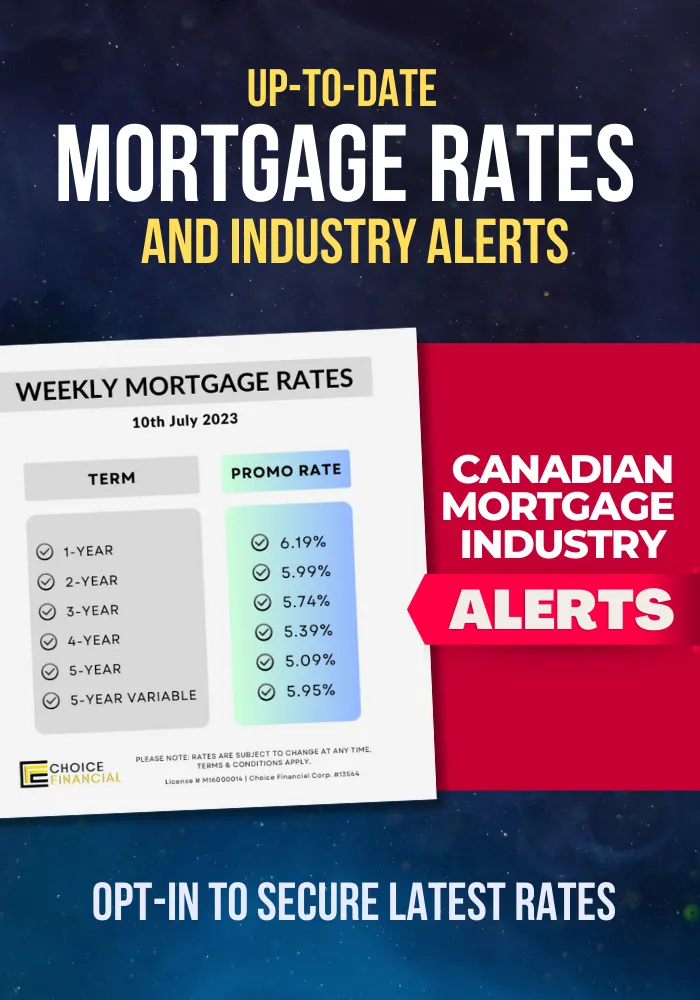
Sign up for our weekly mortgage rates and industry news.
Visit Our Office
Located in the heart of East York, we're here to serve you in person or virtually across Canada.
785 Millwood Rd
East York, ON M4G 1W2
Phone
647-638-6358
Hours
Mon-Fri: 9AM-6PM
Sat-Sun: By Appointment


Incorporated Your Business? Here’s How It Changes Your Mortgage (And What to Do About It)
Incorporated Your Business? Here’s How It Changes Your Mortgage (And What to Do About It)
I was on the phone the other day with a buddy of mine—let’s call him Mike. He runs a successful renovation company here in the GTA. He’d just incorporated his business, feeling good about the tax savings and liability protection.
Then he dropped the question:"Greg, I want to buy a new place in Burlington this spring. Did incorporating screw up my mortgage?"
He’s not alone. I get this call all the time from self-employed pros across Ontario—contractors, consultants, real estate investors. The answer isn't always simple, but with the right plan, you can absolutely get where you want to go.
Why Incorporation Changes the Game with Lenders
When you incorporate, you're no longer just a person earning income. In the eyes of a lender, you’re now the shareholder of a company. And that company paysyou—whether in salary, dividends, or a mix of both.
From a lender’s point of view, this means you’ve taken a step further away from "traditional" employment. They now want to understand how you’re compensating yourself, how stable that structure is, and whether it’s consistent over time.
And here’s the hard truth I had to tell Mike: if you made multiple changes in the same calendar year—like employee to sole proprietor to incorporated—the file gets confusing. Lenders like tidy income stories. Anything that raises questions about how you’re paying yourself can lead to delays or a decline.
Ontario Case Study: The Renovator Who Changed Too Fast
This happens more than you’d think. We worked with a client—we’ll call him Steve—who ran a successful renovation company in Hamilton. In a single year, Steve moved from being an employee to running a sole proprietorship, to finally incorporating his business.
On paper, it looked like chaos. He had three different income types showing up in one tax year, with no consistent pattern. When Steve came to us for a mortgage, we couldn’t get an A lender to sign off—despite solid earnings. Why? Too much change, not enough clarity.
We placed him with a B lender temporarily. The rate was higher (around 5.49% on a 5-year fixed at the time), but it bought us time to build a track record. Once he had a full tax year under his incorporated structure, with clear salary draws, we were able to switch him back to an A lender at a much lower rate.
Key takeaway for any Ontario business owner: If you’re going to incorporate,commit to it. Decide early how you’re going to pay yourself, and stick with it.
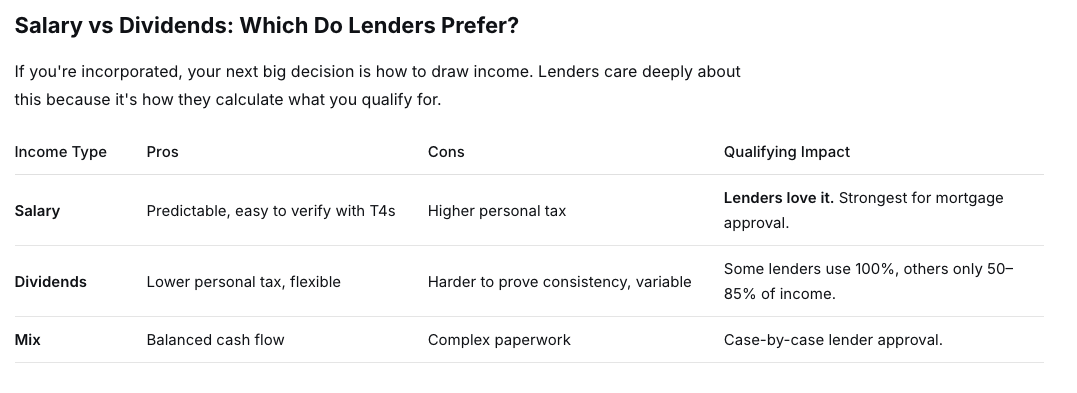
Salary vs Dividends: Which Do Lenders Prefer?
Should I Wait to Incorporate Until After I Buy?
This is one of those questions that rarely gets asked up front—but we wish it did.
If you're early in your self-employed journey and know a purchase or refinance is coming, it may make sense tostay a sole proprietor until the deal is done. Why? Because lenders are already used to how sole proprietor income shows up. If you've been filing that way for two years, you’re mortgage-ready. Incorporating resets the clock.
I’m not saying don’t incorporate—just time it strategically. If the house hunt is happening in the next 12 months in the GTA or Hamilton,let’s talk first.
What Do Lenders Really Look At When You’re Incorporated?
It’s not just your personal income anymore. Lenders now want to see:
Two years of corporate financials, ideally with aNotice-to-Readerprepared by an accountant
Your personalT1 Generals(tax returns), showing how you pay yourself
Apattern in income type: consistent salary or dividends, not bouncing between the two
Aclean corporate structure: ideally, no personal expenses buried in the books
No late tax filingsor messy bookkeeping
And here's a little insider tip: the more organized your financials are, the more confidence the underwriter has in you. We’ve seen files get approved on strong retained earnings alone—because the books were airtight.
Red Flags That Hurt Borrowing Power for Incorporated Clients in Ontario
Switching income types mid-year(e.g., half salary, half dividends, no clear pattern)
Corporate losses on paper, even if you’re doing well in real life
Personal expenses buried in corporate write-offs(think: trucks, cell phones, meals for "clients" that are really just dinner with friends)
No formal financials(like not having a proper Notice-to-Reader prepared)
Late tax filings—CRA arrears are a huge no-go for A lenders
What If I Need to Refinance While I’m Newly Incorporated?
Life doesn’t always wait for your two-year tax history to mature. Sometimes you need to refinance—whether to consolidate debt, pull equity for a renovation, or handle an unexpected expense.
If you've just incorporated and don’t yet have that clean track record, we often look at:
A B lender, short term (1–2 years), while you build qualifying income
Using corporate financials + retained earningsif your personal draws are low
If you’re still in your first year post-incorporation, possiblyqualifying under your last full year as a sole proprietor, depending on timing and lender
How to Stay "Mortgage-Ready" as an Incorporated Business Owner in Ontario
Talk to your accountant and broker at the same time.Your accountant’s job is to minimize tax. Our job is to help you qualify for your goals. Sometimes those conflict. Aligning early saves heartache.
Don’t change income strategies mid-year.Switching from salary to dividends in June muddies the waters. Lenders want two years of consistency, or at least one clean year.
File your taxes on time and keep them clean.Late filings, losses, or messy bookkeeping? All red flags. You don’t need massive profits, but you do need professional documentation.
Keep a paper trail for retained earnings or owner draws.Some lenders will "gross up" your qualifying income if it’s clear you’re leaving profit in the company. But that’s only possible with proper books.
Quick Glossary (For the Busy Ontario Professional)
Incorporated Business: A legal structure that separates the business from the individual owner. Often done for tax planning or liability protection.
Sole Proprietor: A self-employed person who reports income directly on their personal tax return, without a separate legal business.
Salary: Income drawn from the corporation, typically with T4 slips and payroll deductions.
Dividend: A payout from corporate profits to shareholders, reported on a T5. Often taxed at a lower rate than salary.
B Lender: A lender who works with clients who don’t fit traditional bank guidelines. Higher rates, but more flexibility.
A Lender: Major banks and credit unions with strict income and credit rules.
Notice-to-Reader: A type of financial statement prepared by an accountant. Lenders often require this when reviewing corporate income.
Qualifying Income: The amount a lender uses to determine how much you can borrow. May not match your gross income exactly.
Gross-Up: A method of inflating reported income for qualifying purposes, often used for non-taxable or retained earnings.
Retained Earnings: Profits left in the corporation rather than paid out. Can sometimes be factored into income with proper documentation.
FAQs from Ontario Business Owners
Can I qualify for a mortgage right after I incorporate?
It depends. Most A lenders want to see two full tax years under your new structure. But some flexible lenders may work with one year if your income is strong and consistent.
What if I’ve already changed income types mid-year?
Don’t panic—but do pause. Talk to usbeforeyou file your taxes. We may be able to find a workaround or place you with a short-term B lender.
Do lenders prefer salary or dividends?
Most prefer salary because it’s easier to verify and consistent. But we work with lenders who accept dividends too—it just requires clean, consistent reporting.
Can I use retained earnings or corporate assets to qualify?
Yes, in some cases. But you’ll need a lender who understands business structures, and you’ll need solid accounting to back it up.
What’s the fastest path back to an A lender if I’ve incorporated?
Get one full year of clean corporate income, file on time, and document how you pay yourself. Then we reassess and re-qualify.
Final Thoughts
Incorporating your business can be a smart move for tax planning, liability, and long-term growth—but it adds layers when it comes to mortgage planning.
That’s why I always tell my clients:bring me in early. A quick conversation with your mortgage team before you switch income types can save you thousands in rates and frustration.
Give me a call or fill out an application atthis linkand our team will get in touch with you to start building a plan that suits you.

Want to work with us?
Let's discuss your mortgage goals and create a personalized strategy that works for you.
Our team brings years of experience in residential and commercial lending, with a commitment to finding solutions that fit your lifestyle and financial objectives.
Contact us today for a no-obligation consultation.
Choice Financial Corp. #13564
Independently owned and operated
Licensed in
Ontario FSRA # 13564
Alberta: RECA
CF Choice Financial Corp:
B.C: BCFSA #MB605782
COMPANY
CUSTOMER CARE


Copyright 2026. Choice Financial Corp.. All Rights Reserved.
Privacy Policy - Terms ofUse